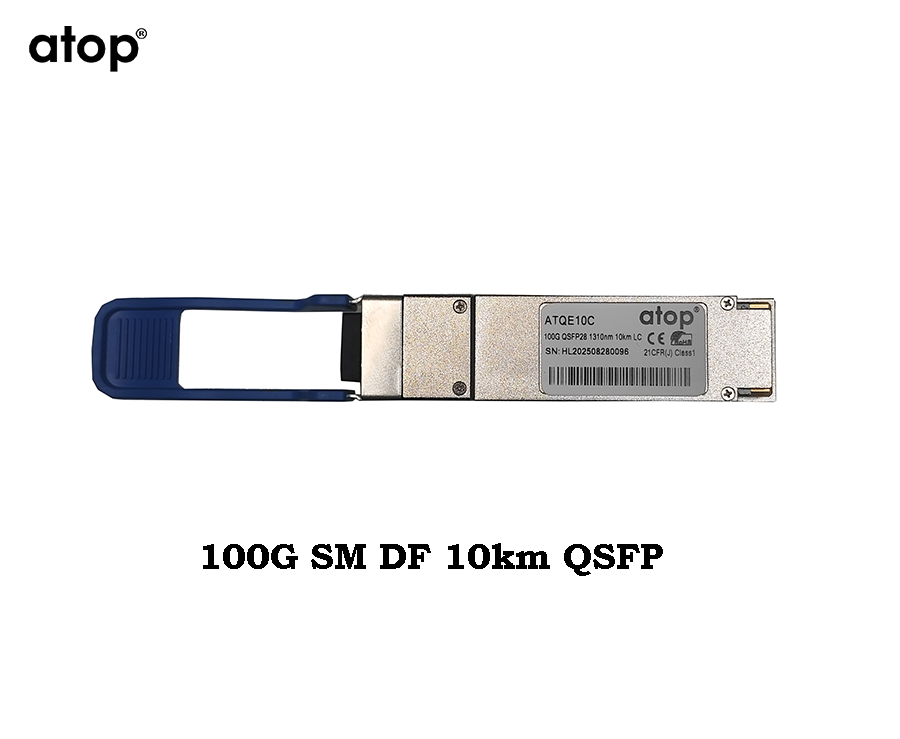
Inhouse product
Features:
Hot pluggable QSFP28 MSA form factor
Compliant to IEEE 802.3ba 100GBASE-LR4
Up to 10km reach for G.652 SMF
Single +3.3V power supply
Operating case temperature: 0~70oC
Transmitter: cooled 4x25Gb/s LAN WDM EML TOSA (1295.56, 1300.05, 1304.58, 1309.14nm)
Receiver: 4x25Gb/s PIN ROSA
4x28G Electrical Serial Interface (CEI-28G-VSR)
Maximum power consumption 4.0W
Duplex LC receptacle
RoHS-6 compliant
Applications:
100GBASE-LR4 Ethernet Links
Infiniband QDR and DDR interconnects
Client-side 100G Telecom connections
1. General Description:
This
product is a 100Gb/s
transceiver module designed for
optical communication applications compliant to 100GBASE-LR4 of the
IEEE P802.3ba standard. The module converts 4 input channels of 25Gb/s
electrical data to 4 channels of LAN WDM optical signals and then multiplexes
them into a single channel for 100Gb/s optical transmission. Reversely on
the receiver side, the module de-multiplexes a 100Gb/s
optical input into 4 channels of LAN WDM optical signals and then converts them
to 4 output channels of electrical data.
The central wavelengths
of the 4 LAN WDM channels are 1295.56, 1300.05, 1304.58 and 1309.14nm as
members of the LAN WDM wavelength
grid defined in IEEE 802.3ba. The
high performance cooled LAN WDM
EA-DFB transmitters and high
sensitivity PIN receivers
provide superior performance for 100Gigabit Ethernet applications
up to 10km links and compliant to optical interface with IEEE802.3ba Clause 88
100GBASE-LR4 requirements.
The product is designed
with form factor, optical/electrical connection and digital diagnostic
interface according to the QSFP+ Multi-Source
Agreement (MSA). It has been designed
to meet the harshest external operating conditions including
temperature, humidity and EMI interference.
2. Functional Description:
The
transceiver module receives 4 channels of
25Gb/s electrical data, which are processed
by a 4-channel Clock and Data
Recovery (CDR) IC that reshapes and
reduces the jitter of each electrical
signal. Subsequently, each of 4 EML
laser driver IC's converts one of the
4 channels of electrical signals to an
optical signal that is transmitted from one
of the 4 cooled EML lasers which are
packaged in the Transmitter Optical Sub-Assembly (TOSA). Each laser launches
the optical signal in specific wavelength specified in
IEEE802.3ba 100GBASE-LR4 requirements. These
4-lane optical signals will be optically multiplexed into a single
fiber by a 4-to-1 optical WDM MUX. The optical output power of
each channel is maintained constant by
an automatic power control (APC) circuit. The
transmitter output can be turned off by TX_DIS hardware signal and/or 2-wire
serial interface.The receiver receives 4-lane LAN WDM optical signals. The
optical signals are de-multiplexed by a
1-to-4 optical DEMUX and
each of the resulting 4 channels of optical signals is fed into one of the 4
receivers that are packaged into the Receiver Optical Sub-Assembly (ROSA). Each
receiver converts the optical signal to an electrical signal. The regenerated
electrical signals are retimed and de-jittered and amplified by the RX portion
of the 4-channel CDR. The retimed 4-lane output electrical signals
are compliant with IEEE CAUI-4 interface
requirements. In addition, each received
optical signal is monitored by the DOM section. The monitored value
is reported through the 2-wire serial interface. If one or more received
optical signal is weaker than the threshold level, RX_LOS hardware alarm will
be triggered.
A single +3.3V power
supply is required to power up this product. Both power supply pins VccTx and
Module Select (ModSelL) is an input pin. When held low by the host, this
product responds to 2-wire serial communication commands. The
ModSelL allows the use of this
product on a single 2-wire interface bus – individual
ModSelL lines must be used.
Serial Clock
(SCL) and Serial Data (SDA) are
required for the 2-wire serial bus
communication interface and enable the host to access the QSFP28 memory map.
The ResetL pin enables a
complete reset, returning the settings to their default state, when a low level
on the ResetL pin is held for longer than the minimum pulse length. During the
execution of a reset the host shall disregard all status bits until it indicates
a completion of the reset interrupt. The product indicates this
by posting an IntL (Interrupt) signal
with the Data_Not_Ready bit negated in the
memory map. Note that on power up (including hot insertion) the module should
post this completion of reset interrupt without requiring a reset.
Low Power
Mode (LPMode) pin is used to set the
maximum power consumption for the product in
order to protect hosts that are not capable of cooling higher power modules,
should such modules be accidentally inserted.
Module Present
(ModPrsL) is a signal local to the
host board which, in the absence of a
product, is normally pulled up to the host Vcc. When the product is
inserted into the connector, it completes the path to ground through a resistor
on the host board and asserts the signal. ModPrsL then indicates its present by
setting ModPrsL to a “Low” state.
Interrupt (IntL) is an
output pin. “Low” indicates a possible operational fault or a status critical
to the host system. The host identifies the source of the interrupt using the
2-wire serial interface. The IntL pin is an open collector output and must be
pulled to the Host Vcc voltage on the Host board.
Pin Definition:
|
PIN |
Logic |
Symbol |
Name/Description |
Notes |
|
1 |
|
GND |
Ground |
1 |
|
2 |
CML-I |
Tx2n |
Transmitter Inverted Data Input |
|
|
3 |
CML-I |
Tx2p |
Transmitter Non-Inverted Data output |
|
|
4 |
|
GND |
Ground |
1 |
|
5 |
CML-I |
Tx4n |
Transmitter Inverted Data Input |
|
|
6 |
CML-I |
Tx4p |
Transmitter Non-Inverted Data output |
|
|
7 |
|
GND |
Ground |
1 |
|
8 |
LVTLL-I |
ModSelL |
Module Select |
|
|
9 |
LVTLL-I |
ResetL |
Module Reset |
|
|
10 |
|
VccRx |
+3.3V Power Supply Receiver |
2 |
|
11 |
LVCMOS-I/O |
SCL |
2-Wire Serial Interface Clock |
|
|
12 |
LVCMOS-I/O |
SDA |
2-Wire Serial Interface Data |
|
|
13 |
|
GND |
Ground |
|
|
14 |
CML-O |
Rx3p |
Receiver Non-Inverted Data Output |
|
|
15 |
CML-O |
Rx3n |
Receiver Inverted Data Output |
|
|
16 |
|
GND |
Ground |
1 |
|
17 |
CML-O |
Rx1p |
Receiver Non-Inverted Data Output |
|
|
18 |
CML-O |
Rx1n |
Receiver Inverted Data Output |
|
|
19 |
|
GND |
Ground |
1 |
|
20 |
|
GND |
Ground |
1 |
|
21 |
CML-O |
Rx2n |
Receiver Inverted Data Output |
|
|
22 |
CML-O |
Rx2p |
Receiver Non-Inverted Data Output |
|
|
23 |
|
GND |
Ground |
1 |
|
24 |
CML-O |
Rx4n |
Receiver Inverted Data Output |
1 |
|
25 |
CML-O |
Rx4p |
Receiver Non-Inverted Data Output |
|
|
26 |
|
GND |
Ground |
1 |
|
27 |
LVTTL-O |
ModPrsL |
Module Present |
|
|
28 |
LVTTL-O |
IntL |
Interrupt |
|
|
29 |
|
VccTx |
+3.3 V Power Supply transmitter |
2 |
|
30 |
|
Vcc1 |
+3.3 V Power Supply |
2 |
|
31 |
LVTTL-I |
LPMode |
Low Power Mode |
|
|
32 |
|
GND |
Ground |
1 |